Showing posts with label loyalty. Show all posts

Tuesday, 23 April 2013

Self-serve or served?

Just read today that the Indonesian loyalty start-up Squiryl has ceased operations. (Read the article here. ) The CEO and founder of the start-up cited the reason to be an issue of sustainability, that the business was not envisioned the way it turned out to be. In his words, it became "a resource intensive operations involving full time sales and support staff. And that was just the problems on the brand acquisition side."

The loyalty business was never something that one expects the retailer to be 'self-reliant' or 'self--sufficient'. Yes, they would want access and control. But operationally, it would be impractical to think that a retailer in full-scale day-to-day operating challenges, will have the time, effort, or the resource, to run an effective program in a laisser-faire manner. A customer membership program requires dedicated resource and constant intellectual input from a marketer that thinks "lifecycle management" and not "advertising and promotions".

There has been constant hype in the 'loyalty business' and that perennial myth of the pot of gold at the elusive end of the rainbow. But marketers need to get one thing clear: a loyalty tool/platform/software, or whatever you may choose to call it, is just really just that: a machine. It is an instrument for you to run a business. It is a framework on which you can execute your strategy. It is not a panacea. It is not a miracle cure. You need to work it before it will work for you.

And I think in many ways, they story of the Squiryl should give loyalty platform builders a clear message: you have to choose your role in the space and be prepared to fulfill that role. You cannot be all things to everyone.

Tuesday, 1 November 2011

Virtual Currency may no longer be "virtual" anymore

Just a moment ago, Finextra tweeted an piece of Amex-related news: American Express has filed a patent for a system and method for using loyalty rewards as a currency.Any loyalty practitioner will find this statement odd. Loyalty rewards mostly operate on the concept of a 'rewards currency'. So, what is so different about this? Further reading reveals that 'currency' in question, is one that is 'virtual' in nature. By 'virtual', it refers to currency that exists in the 'virtual' or a.k.a. internet/online world.

For hardcore online gamers or even Facebook amateur players, the 'virtual currency' is 'virtual money' used in the purchase of all things, well, virtual; like a potion here and there, or a zombie to grow your garden. As with money in the real-world, you have to 'work' to 'earn it'.

Amex put in $30 million in September for a 4-year-old company Sometrics that helps gaming companies set up the infrastructure to enable virtual-currency. With this, they may have made the most far-sighed investment in new business yet.

As the social-cultural sphere is increasing entrenched within the 'virtual', so is the economy. The world painted in the movie series Matrix may be a teeny bit far-fetched, but who is to say that the clothes, food supplies, armour and magic potions you buy in the cyber world are less important or valuable that the tangible real ones in the world?

Food for thought.


Sunday, 5 June 2011

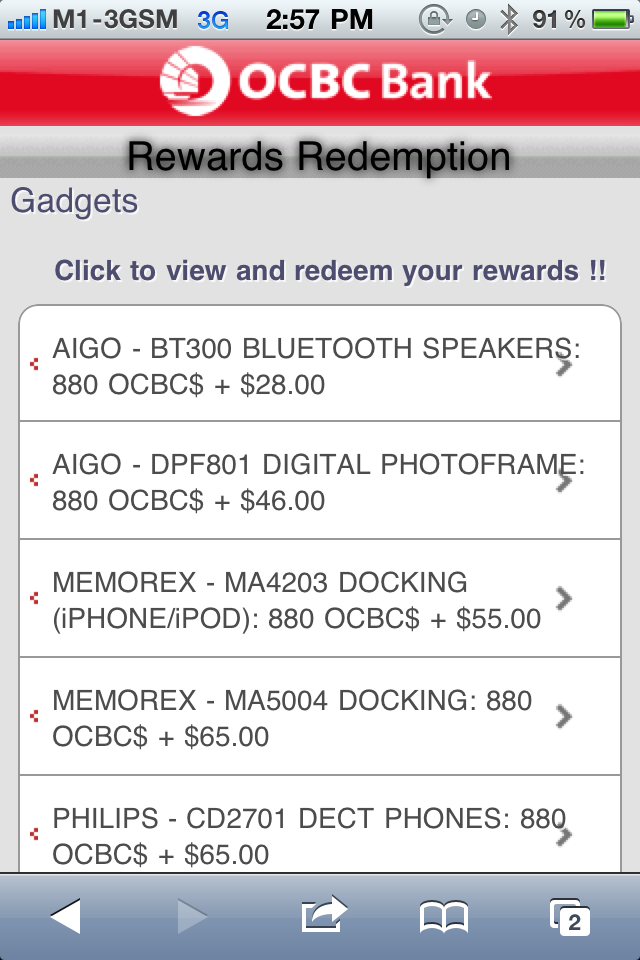
Accessing your rewards on a phone

In March 2011, OCBC Cards managed to complete the most large-scale loyalty platform implementation in recent memory. I was glad to be part of the project team to have made it happen.

In the time I have spent in customer loyalty, the primary focus had been on a few key elements, namely, the value of the reward currency, the relevance of the rewards earned, and the rate at which they are earned.

Back then, no one had anticipated the proliferation of social networking and the widespread use of the smart phone as a banking medium.

As these developments unfold in ever-increasing frequency and speed, it dawned on me, that a customer's view on rewards would also have altered by these changes. This is an epiphany that led me to think that the next battle ground in rewards is not in the 'earn', but the 'burn'.

While the rest of the card banking community tries to out-do each other in multiplier points earn, perhaps enabling a quick and easy way for customers to access their rewards currency anytime, anywhere, is the next big thing to disrupt the market?

I hope anyone who reads this will take a moment to visit the OCBC rewards mobile website: mobile.ocbc.com.

Although this is a mobile web-based service at the moment, I hope that in time, our recently released Android mobile banking app will incorporate rewards as a key functionality.

Meanwhile, have a look a a video on the much-talked about OCBC Android mobile banking app.


ZDNet interview of mobile banking product manager.

Wednesday, 10 March 2010

Loyalty Currency - What do you prefer?

The question of suitability in loyalty currency is the single most intriguing question that has never quite gotten a scientific and clinical treatment. In particular, I do not believe that any formal study has been conducted with regards to loyalty currency preference in payment cards.

I am of the opinion that, despite cultural and social disparities in different markets, there must be some partiality towards one type of loyalty currency to another.

Points? Miles? Or something else?

If you could take a minute to answer this poll, I would be eternally grateful.
http://polls.linkedin.com/p/80433/avpnn

Wednesday, 19 August 2009

The Changing Face of Loyalty in Payment Cards

Some time ago, I blogged about a soon-to-be-published whitepaper on the subject of loyalty in payment cards, and how commoditisation is going to change the playing field of how programs should be run.

The paper has been kindly picked up by VRL and will be published in abridged form in the latest issue of Cards International. The full-length paper can be found here on Insight's website.

All comments welcome.

"Pick a card! Any card!"

As a loyalty marketing practioner, you find the work hard, time-consuming, and sometimes unappreciated. However, as professionals, we strive to maintain sanity in a crazy world and find relevance in what we do. This also means looking towards the altruistic and take heart that what we do really made a difference in lives. Still, there are times when it is necessary to laugh at ourselves in the absurdity of the work we do. Here are a few gems I found on the web. Hope you enjoy them as much as I did.


Friday, 3 July 2009

The Semiotics of Loyalty

Several weeks ago, I began the project of writing a whitepaper on loyalty. During the course of preparation, it occurred to me that the word loyalty means a multitude of things. In marketing, the very mention of loyalty seems to evoke much excitement. I have come to realise that even marketing professionals themselves tend to take the meaning of loyalty for granted.

Umberto Eco is a best-selling novelist, a renowned academic in the study of semiotics, and my favourite author. The rather obscure field of his expertise is about the study of signs and symbols, their meanings, and the way in which those meanings are conveyed. Broadly speaking, language and words are also signs and symbols on themselves. The most interesting aspect of this study is the transient nature of the interpretation of meaning. If we took this philosophical approach to the word loyalty, the discussion on its meaning become immensely interesting.

Loyalty means very different things to different parties in the loyalty value chain. It remains an illusive and multi-faceted concept in the business world. As a marketer who is endeared to the semiotics, I cannot help but believe that the we cannot take a laissez-faire approach to the definition of loyalty in the business context as we do in philosophy. There has been too much talk and not enough scientific discourse on the concept. Before we can all agree on what loyalty means, we cannot advance in the way loyalty marketing can be conducted.

The chairman of my former employer, Aneace Haddad (click here for his blog), had this to say after reviewing my whitepaper, "Maybe someone needs to provide a linguistic framework to set things straight from the beginning."

I hope my soon-to-be-published paper will be the beginning of our own industry advocacy to do exactly that.


Tuesday, 16 June 2009

The Relevance of Loyalty in Credit Cards Today

A cursory check on the major banks in Singapore, Malaysia, Thailand, Philippines, and India revealed that almost all of the card products come with a default rewards program of some sorts. The most common form of rewards currency are points, rebates, and airline miles.

There was a time when loyalty programs were deemed the 'killer application' for credit cards. But there seems to be a growing proliferation of 'run-of-the-mill' programs.

What is the relevance of a card loyalty program to an issuer? Have we lost sight of the true business reasons for wanting a loyalty program in the first place?

In the next few weeks, I will be working on a white paper to explore this topic. In the meantime, do share with me your views.

The beginning of something... I think.

They say that procrastination is bad. I agree. I have long since wanted to start a blog on card and loyalty marketing issues rather than a "personal" blog with endless meanderings. But it never really got off the ground.

This is a bad sign of "having the means but lacking the will". So, forcing myself to leave meaningful footprint on the web, here's my maiden post.

The world of card marketing is crazy, and wonderful at the same time. Life would be boring without it.